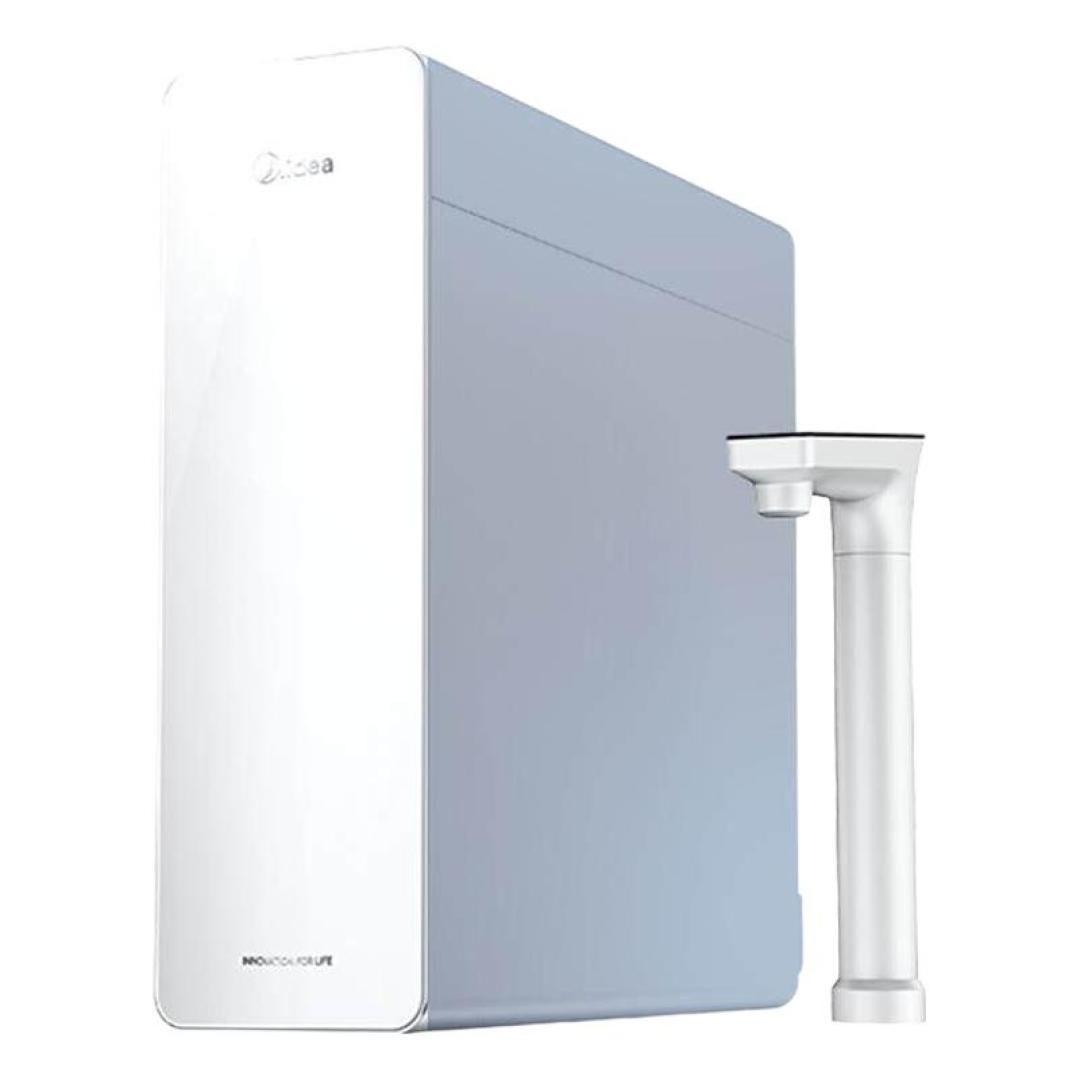
Midea Pengpai PRO 1200G Water Purifier Review 2026: Zero-Stale-Water RO at ¥1,846
The Midea Pengpai PRO 1200G (MRC2887-1200G) is the 1200-gallon RO purifier that made zero-stale-water drinking mainstream at ¥1,845.88 — a 146-day low on Tmall's subsidy program, down from the ¥2,699 list price. SMZDM's all-price-band red/black list praises Midea's 0-scale-inhibitor stance while warning that filter costs, not the machine price, are the real long-term bill; Xiaohongshu owners love the national-subsidy deals and the 5-year RO filter, but the "anti-human filter swap" and "filter life shrink" threads are the recurring caveats. Here is the honest picture before you buy.
Midea Pengpai PRO 1200G Water Purifier Review 2026: Zero-Stale-Water RO at ¥1,846
The Midea Pengpai PRO 1200G (MRC2887-1200G) is the under-sink RO purifier that turned “zero stale water” into a mainstream feature at a national-subsidy price. On Tmall it’s been selling at ¥1,845.88 under the subsidy program (list ¥2,699 — a 146-day low as of June 8), and SMZDM’s history shows the machine touching ¥1,359.2 with the 20% subsidy in June 2025, making it one of the most deal-tracked 1200G units in its band. The headline specs: 1200G throughput at ~3.17L/min initial flow, RO filtration at 0.0001-micron precision, full-time zero-stale-water (pure-water backflush so the first morning cup is drinkable), a 5-year long-life RO filter, Midea’s “0 scale inhibitor, 0 stale water, 0 additives” triple promise, and a slim under-sink chassis. SMZDM’s 56-like “water purifier red/black list” calls the machine’s price band the 1200G battleground and names Midea’s Paskal RO membrane (97% salt rejection) a red-list pick; Xiaohongshu’s 69-like “don’t be a sucker, the national-subsidy deal is too sweet” and 101-like “618 install complete” threads capture the enthusiasm, while the 19-like “anti-human filter swap design” and 22-like “labeled 2 years, actually lasts 1” threads are the caveats. Conclusion: ✅ Best value for families who drink a lot of water, want the first-cup-safe zero-stale-water behavior, and plan to keep the machine 5+ years; ⚠️ skip if you hate spending on filter swaps or want a name-brand Dow membrane at this price.
Specifications
| Specification | Detail |
|---|---|
| Model | Midea Pengpai PRO 1200G (MRC2887-1200G) |
| Throughput | 1200G (~3.17L/min initial flow) |
| Filtration | RO reverse osmosis, 0.0001-micron precision |
| Stale-water tech | Full-time zero stale water (pure-water backflush) |
| Filter | 5-year long-life RO filter |
| Additives | 0 scale inhibitor, 0 stale water, 0 additives |
| Chassis | Slim under-sink design |
| Price (Aug 2026) | ¥1,845.88 Tmall subsidy (146-day low, 06-08); list ¥2,699; historical low ¥1,359.2 (2025-06) |
| Listing | Tmall flagship + JD, SMZDM subsidy-program band leader |
What Chinese Users Say
The Pengpai PRO 1200G lives in the most competitive water-purifier price band in China — SMZDM’s red/black list calls ¥1,500-2,000 “the 1200G battleground” — and the conversation splits between buyers who understand filter economics and first-timers who only see the machine price. Three themes dominate: whether zero-stale-water is worth it, whether the 5-year RO filter actually delivers, and the recurring “filter swap” complaints.
The Zero-Stale-Water & Subsidy Deal Story
“Don’t be a sucker — the Midea national-subsidy leak price is too sweet.” — Xiaohongshu user @Xiaohongshu67E1380A (69 likes, 2025-04-17)
“Bought the Midea under-sink purifier Pengpai 1200G during 618, installation complete.” — Xiaohongshu user @Southern Summer (101 likes, 2022-06-07)
“Got the Midea 1200G Pro at 1,595.” — Xiaohongshu user @Call Me XiaoZhong (2 likes, 2025-05-14)
The deal-watching crowd drives most of the Pengpai PRO conversation. The machine’s subsidy-stacked pricing (¥1,359-1,846 depending on the subsidy tier and coupons) makes it a frequent deal feature on SMZDM, and the “leak price” threads on XHS document buyers locking in sub-¥1,600 prices. The functional pitch is zero stale water: unlike older RO machines where the overnight first cup shows a TDS spike and gets poured down the drain, the backflush keeps every cup drinkable — SMZDM’s guide treats this as the single most valuable RO upgrade of recent years.
The 5-Year RO Filter: The Long-Term Bill
“Midea purifier filter deep-dive: is the RO filter really high-tech?” — Xiaohongshu user @LittleWheatMama (33 likes, 2024-12-21)
“Used my Midea purifier’s RO filter for 5 years.” — Xiaohongshu user @KingYu (40 likes, 2025-10-08)
“Avoid Midea purifiers — filter labeled 2 years but actually lasts 1.” — Xiaohongshu user @YiErSan (22 likes, 2025-10-16)
“About the Xinghe 1200 Pro: this Midea filter actually only lasted 5 months.” — Xiaohongshu user, (29 likes, 2025-07-25)
SMZDM’s core buying advice is blunt: “the filter is the real bill, not the machine.” The Pengpai PRO’s 5-year RO filter is its long-term-cost argument — at typical family usage, amortizing the machine plus filter changes over 5 years lands far below the “filter assassin” machines SMZDM blacklists (like the dual-core Xiaomi 1200G Pro, whose secondary 400G filter dies at 2 years). But XHS threads show the flip side: filter life depends on feed water quality and daily volume, and owners in hard-water or high-usage homes report the RO membrane degrading faster than the sticker claims. The “5 months” and “2 years → 1 year” threads are the extreme cases, but they explain why buyers should read the total filtered-water spec (L) rather than the year label.
The Anti-Human Filter Swap Complaint
“Midea Pengpai filter swap is an anti-human design.” — Xiaohongshu user @MyNameIsChenSanShui (19 likes, 2025-06-13)
“Midea Pengpai purifier’s false advertising really screwed me.” — Xiaohongshu user @BlueZebra (30 likes, 2024-05-08)
“Midea Pengpai 1000G purifier stopped producing water.” — Xiaohongshu user @StepYouth (24 likes, 2024-06-16)
The most repeated functional complaint is filter-swap ergonomics: the under-sink twist-and-pull cartridge design requires reaching deep into the cabinet, and several XHS threads describe the swap as frustrating (“anti-human”). The “false advertising” and “stopped producing water” threads are individual failures, not systemic — but together they form the main negative cluster alongside the filter-life doubts. For buyers, the practical takeaway is to confirm the filter-swap procedure before buying (Midea’s official videos help) and to budget for a filter change around year 1.5-2 for the composite pre-filter, not just the 5-year RO.
The Series Confusion: Pengpai vs Baize vs Xinghe
“Is the Midea Xinghe 1200G Pro a good price?” — Xiaohongshu user @Bei (126 likes, 2025-11-01)
“Almost talked out of the Midea Xinghe 1200G Pro.” — Xiaohongshu user @Xixili (90 likes, 4 days ago)
“0-scale-inhibitor purifier list, purely self-organized.” — Xiaohongshu user @Wanfeng (6 likes, 2 days ago)
Midea’s model naming (Pengpai, Baize, Xinghe, and the “white moonlight” variants) generates constant confusion — the 126-like “is this a good price” thread and the 90-like “almost talked out of it” thread both stem from buyers trying to figure out which series they were looking at. The practical difference: Pengpai PRO 1200G uses Midea’s own Paskal RO membrane (97% salt rejection, cheaper filters), while Xinghe uses imported Dow membrane (higher filter cost — SMZDM says not worth it unless you specifically trust Dow). The Baize Max 1200G is the long-standing value king at ~¥1,270. For most buyers the Pengpai PRO’s 5-year RO + cheaper replacement filters make it the better long-term deal than the Xinghe.
Pros & Cons
Pros:
- Full-time zero-stale-water: first morning cup is drinkable, no TDS-spike waste
- 1200G throughput (~3.17L/min) — no queueing for water even with a big family
- 5-year RO filter keeps long-term cost low vs “filter assassin” rivals
- Midea’s 0 scale inhibitor / 0 stale water / 0 additives stance — industry-unique per SMZDM
- Subsidy pricing: ¥1,845.88 current low, sub-¥1,600 historically
- Slim under-sink chassis fits most cabinets
- Midea nationwide service + app integration
Cons:
- Filter-swap ergonomics widely called “anti-human” on XHS
- Filter life varies with water quality — year labels can overpromise
- Paskal membrane (not Dow) — Dow fans should look at Xinghe at higher filter cost
- 0-stale-water backflush adds some water usage vs basic units
- No TDS display on the base faucet (check variant)
- Model naming across Pengpai/Baize/Xinghe confuses first-time buyers
vs Competitors
| Spec | Midea Pengpai PRO 1200G | Midea Baize Max 1200G | Xiaomi 1200G Pro | JD Jingzao Lingxi 1200G Pro 2.0 |
|---|---|---|---|---|
| Throughput | 1200G (3.17L/min) | 1200G | 1200G | 1200G |
| RO membrane | Paskal (own), 97% | Paskal, 97% | Dual-core (800G+400G) | Dow 16-page |
| RO life | 5 years | 6 years | 8 yrs main + 2 yrs secondary | 6.5 years |
| Stale water | Full-time zero | Zero | Zero | Zero |
| Scale inhibitor | No | No | No | No |
| Price (Aug 2026) | ¥1,846 | ~¥1,270 | ¥1,880 | ¥1,273 |
The Pengpai PRO 1200G sits in the middle: cheaper than the Xiaomi dual-core (which SMZDM blacklists as a “filter assassin” because its 400G secondary filter dies at 2 years, making total filter cost higher than a single 1200G), more expensive than the value-king Baize Max 1200G (¥1,270), and with a domestic membrane rather than the Jingzao’s Dow. The honest ranking for long-term cost: Baize Max ≈ Jingzao < Pengpai PRO < Xiaomi dual-core.
FAQ
Q: What does “zero stale water” actually do? A: Overnight, water sitting in the RO membrane absorbs minerals back, so the first cup on older machines shows a TDS spike (SMZDM’s test: TDS 25 → 120 overnight). Zero-stale-water purifiers run a pure-water backflush so every cup — including the first one in the morning — is at the same low TDS. You stop pouring the first cup down the drain.
Q: Is the 5-year RO filter real? A: The rating is based on total filtered volume at standard feed water; with typical family use (3-4 people) it holds. With hard water or heavy daily use, XHS owners report faster degradation — the “labeled 2 years, lasted 1” and “5 months” threads are the extreme end. Watch the total-liter spec (rated total filtered volume) and the composite pre-filter, which usually needs swapping around year 1.5-2.
Q: Pengpai PRO vs Baize Max vs Xinghe — which Midea should I buy? A: Baize Max 1200G (~¥1,270) is the long-term value king with a 6-year RO. Pengpai PRO 1200G (¥1,846) adds the newer zero-stale-water marketing and 5-year RO. Xinghe costs more mainly for the Dow membrane — SMZDM says the filter premium isn’t worth it unless you specifically trust Dow. For most buyers: Baize Max for pure value, Pengpai PRO for the newest tech at a still-sane price.
Q: Is the filter swap really that bad? A: The twist-and-pull under-sink cartridge is the #1 XHS complaint (“anti-human design”). It’s manageable — watch Midea’s official swap video and consider buying the pull-out drawer accessory — but budget 10-20 minutes and a clear cabinet. It’s the main ergonomic downside of the machine.
Q: What does the subsidy price actually land at? A: Current Tmall subsidy-program price is ¥1,845.88 (146-day low, list ¥2,699). With the 20% national subsidy window it has hit ¥1,359.2. Check the subsidy status in your region — the 15% tier is broadly active in 2026.
Rating: 8.3/10
Who should buy this: Families who drink a lot of water and want first-cup-safe zero-stale-water behavior; buyers who plan to keep a purifier 5+ years and care about filter economics; anyone comparing against the “filter assassin” Xiaomi dual-core who wants the honest long-term deal.
Who should skip: Budget-first buyers — the Baize Max 1200G at ¥1,270 delivers 90% of the experience; Dow-membrane loyalists who should pay for the Xinghe instead; renters or light users (2 people) who may be better served by a cheaper 600-800G unit; anyone who hates reaching under the sink to swap filters.
Not sure which to choose?
Compare specs side-by-side with our Product Comparator Tool
Related Reviews

Air Fryer vs Oven 2026: Which Is Better for Healthy Cooking?
Air fryer vs oven in 2026: detailed comparison of health benefits, cooking performance, energy efficiency, and cleanabil
Angel 1400G RO Purifier Review 2026: High-Flow Under-Sink Unit With Heater at ¥2,475 — 99% Positive on JD
The Angel (Anjier) 1400G high-flow RO purifier bundle is the ¥2,475.28 under-sink system that SMZDM's Sep 8 deal feed sh
Angel 3611 Wall-Mounted Dispenser Review 2026: Ultra-Slim 6-Temp at ¥639
The Angel 3611 (Y3611BK-G) is the ¥639-1,849 ultra-slim wall-mounted instant-water dispenser that SMZDM's deal history s
Bear 1.7L Stainless Electric Kettle Review: Precision Temperature Control
The Bear 1.7L Stainless Electric Kettle offers 5 precise temperature settings, 304-grade stainless build, and fast 1500W
Bear Mini Rice Cooker 2L Review: Perfect for Singles and Students
The Bear 2L Mini Rice Cooker (DFB-B20A1) offers a compact 2L capacity, 5 cooking functions, and easy storage at ¥129. Pe