Mijia MRH142 Desktop RO Water Dispenser Review 2026: 3-Second Hot Water at ¥1,077
The Mijia MRH142 is the ¥1,022-1,077 countertop RO dispenser that SMZDM's filter-cost analysis calls the smart-buy in the category — 3-second instant heating, NFC tap-to-pour, 3-year RO filter at ¥0.27-0.65/day, versus ¥1.60/day for Philips-class rivals. JD self-operated shows 96% positive. Xiaohongshu's filter-teardown threads praise the engineering; the plastic-odor and after-sales threads are the caveats. Here is the honest review.
Mijia MRH142 Desktop RO Water Dispenser Review 2026: 3-Second Hot Water at ¥1,077
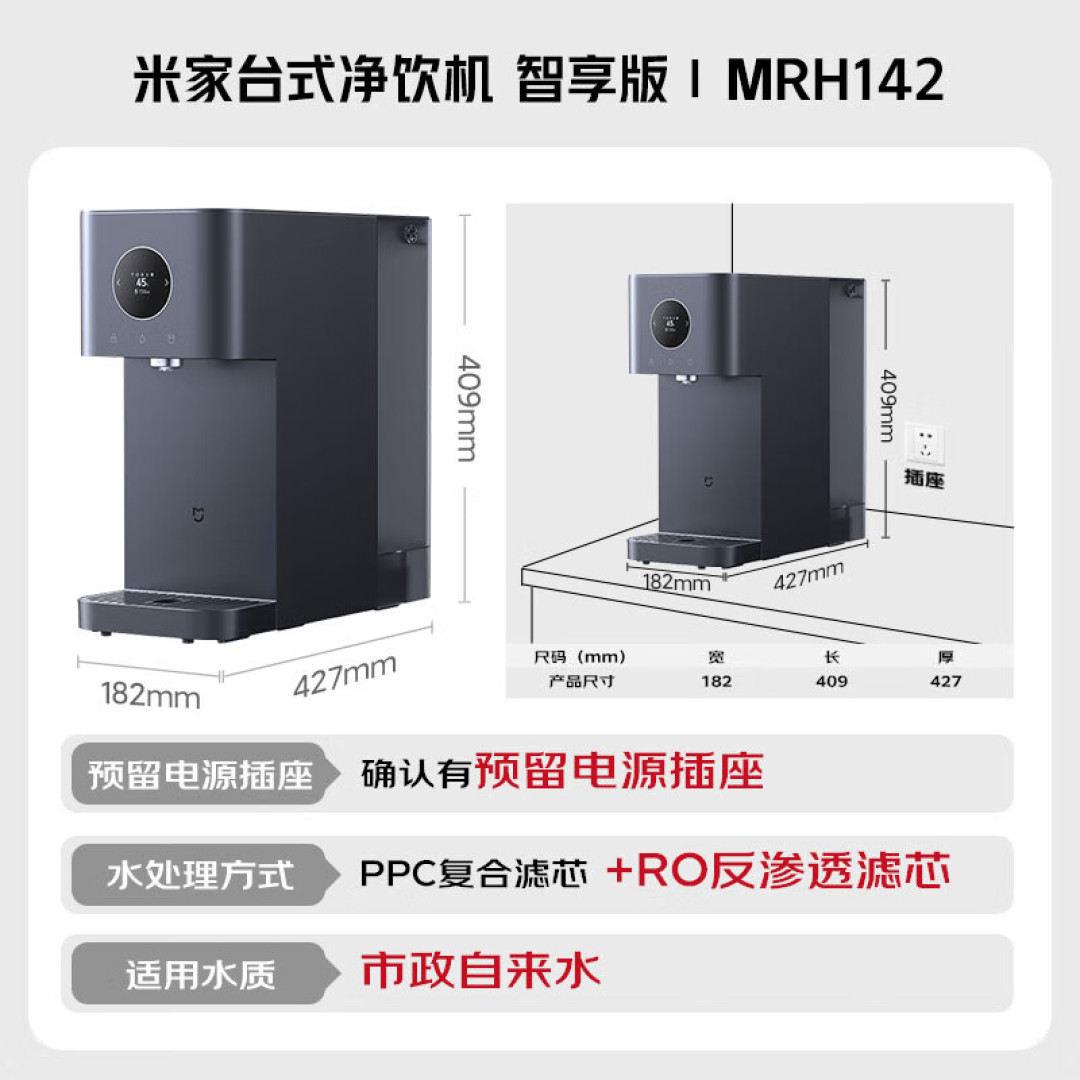
The Mijia MRH142 is the countertop RO water dispenser that wins the Chinese “daily-cost” argument before it even heats a cup: ¥1,022-1,077 on JD self-operated (a 189-day low, list ¥1,645.88), 96% positive rating, and SMZDM’s June filter-cost analysis putting its running cost at ¥0.27-0.65 per day thanks to a 3-year RO filter — against ¥1.60/day for Philips-class rivals and ¥200+/year for bottle-water habits. The spec sheet: RO reverse-osmosis filtration at 0.0001-micron precision (heavy metals, bacteria, viruses, chlorine out), 3-second instant heating with multi-temperature presets, NFC tap-to-pour, XiaoAI voice control and Mijia app integration, a separate pure/waste tank (MRH142b), and no installation — fill, plug in, drink. Xiaohongshu’s 109-like “sawed my Mijia filter open” teardown and 62-like disassembly video are the engineering credibility; the plastic-odor threads, the 50-like “never buying Xiaomi appliances again” rants, and the after-sales horror stories (7 returns!) are the caveats that keep it from a higher score. Conclusion: ✅ Best pick for renters, offices, and families who want zero-install RO water with instant hot water and the lowest per-day cost in the category; ⚠️ skip if you’re odor-sensitive (the plastic-smell threads are real), if you need a full home under-sink system, or if you’d rather pay more up front for a service-backed brand.
Specifications
| Specification | Detail |
|---|---|
| Model | Mijia MRH142 / MRH142b (pure/waste separate tanks) |
| Filtration | RO reverse osmosis, 0.0001-micron precision |
| Heating | 3-second instant, multi-temp (room / 45 / 75 / 85 / boiling) |
| Pour control | NFC tap-to-pour + Mijia app + XiaoAI voice |
| Tanks | Original/waste separation (MRH142b); no installation |
| Filter | PPC composite + RO, 3-year RO life |
| Filter cost | ¥76.5-89.1 per element |
| Daily cost | ¥0.27-0.65/day (SMZDM analysis) |
| Water efficiency | Tier-1 water efficiency |
| Price (Aug 2026) | ¥1,022.97-1,077 JD; ¥1,055 Tmall; list ¥1,645.88 |
What Chinese Users Say
The MRH142’s Chinese conversation is unusually technical for a kitchen appliance: half the threads are filter economics and teardowns, the other half are odor and after-sales complaints. Both halves have hard numbers.
The Filter-Economics Argument
“How to pick a desktop dispenser — the filter structure decides your daily cost. Don’t be fooled by ‘cheap machine’ pricing.” — SMZDM filter-cost analysis (2026-06-17)
“When I sawed the Mijia water filter open.” — Xiaohongshu user @SheCao (109 likes, 2025-11-13)
“Mijia desktop dispenser teardown + principle.” — Xiaohongshu user @yl (62 likes, 2026-06-07)
“Buying a machine is cheap, replacing the filter is expensive’ is the industry’s pain point — some brands’ original filters cost enough to buy a new machine after two swaps.” — SMZDM category analysis (2026-06)
SMZDM’s June comparison table is the document that makes the MRH142’s case: Mijia’s composite+RO design with a 3-year RO filter runs ¥0.27-0.65/day, the Qinyuan S6 hits ¥0.54/day on a ¥198/year maintenance plan, the Biyunquan G7S runs ¥0.64/day on a ¥6,321 machine, and the Philips i2pro tops out at ¥1.60/day — with owners complaining the filter swaps “hurt the wallet.” The 109-like teardown thread shows the actual PPC composite + RO cartridge construction, which is the credibility XHS users trust: the filter is a real, replaceable part at ¥76-89, not a locked-in consumable. The five-year math still favors the dispenser over bottle water (family bottle-water spend typically exceeds ¥2,000/year), but SMZDM’s warning stands: composite filters in hard-water regions fail before their label life, so real daily cost depends on your tap water.
The Plastic-Odor Threads
“The Mijia desktop dispenser (smart version) keeps giving off a plastic smell.” — Xiaohongshu user @zz (7 likes, 2026-03-23)
“Avoid the Mijia cool-boiled-water version!!!!” — Xiaohongshu user @WaWaWaWa (65 likes, 2025-10-12)
“The water from the Mijia dispenser smells bad and they refuse the return.” — Xiaohongshu user @BuBuBuBoA (10 likes, 2026-06-06)
“About the Mijia dispenser water having an odd smell.” — Xiaohongshu user @LikeFluffySoft (29 likes, 2025-11-13)
The odor threads are the MRH142’s most consistent negative signal, and they split into two patterns: first-use plastic smell (new-machine outgassing, which most owners say fades after a few tanks) and persistent odor (which some owners blame on the tank material or filter housing and report as a hard failure). The 65-like “avoid the cool-boiled version” thread is the strongest warning; SMZDM’s analysis doesn’t mention odor at all, which is exactly why the XHS threads matter — they capture what spec sheets don’t. If you’re odor-sensitive, this is the single biggest reason to look at glass-tank rivals or pay more for a premium brand.
The After-Sales Reality
“7 exchanges/returns — Xiaomi after-sales has refreshed my worldview!” — Xiaohongshu user @AWen (6 likes, 2026-06-26)
“Xiaomi cold/hot dispenser after-sales is really worrying!” — Xiaohongshu user @LittleRedBook6457205A (4 likes, 2025-08-20)
“618 blacklist!! Xiaomi dispenser from the official Tmall store!!” — Xiaohongshu user @OhOhOhOh (34 likes, 2026-06-24)
“Never buying Xiaomi appliances again, avoid.” — Xiaohongshu user @YiRanFanTeXi (50 likes, 2025-11-23)
The after-sales threads cluster around the ice-making MRCH132 variant (outlet lid gaps, water leaks at two months) and the odor-return fights — and they’re worth reading before purchase because they’re specific, not generic. The pattern: when the unit works, owners love it; when it fails, the return process through third-party Tmall/JD channels can drag, and the “7 returns” thread is the extreme case. The counter-data: JD self-operated shows 96% positive on the MRH142 specifically, and the sheer volume of MRH142 sales means the complaint pool is proportionally large. The takeaway is practical: buy through JD self-operated (not third-party stores), test the first tank immediately, and know the return window.
The Smart-Home Fit
“Mijia desktop dispenser — hot and cold version.” — Xiaohongshu user @LittleRedBookShuHongXiao (6 likes, 2026-06-25)
“Bought the Mijia stuff and summarized a few countertop dispenser tips.” — Xiaohongshu user @Reviewer_XiaoKang (25 likes, 2026-06-21)
“Mijia instant Max ice-making version arrived.” — Xiaohongshu user @DrinkNoSugarSoda (26 likes, 2026-06-16)
The NFC tap-to-pour is the sleeper feature: tap your phone (or a dedicated NFC card) to the top and water starts, which parents love for kids who can’t use apps, and it’s faster than fiddling with buttons. The Mijia app integration means temperature presets, filter-life tracking, and schedules in one place, and XiaoAI voice control works for hands-full moments. The community consensus from the “tips” threads: set your most-used temperature as the NFC default, and the dispenser becomes a one-touch appliance.
Pros & Cons
Pros:
- Lowest daily cost in the category: ¥0.27-0.65/day with 3-year RO filter vs ¥1.60 Philips-class
- 3-second instant hot water, multi-temperature presets — replaces kettle + thermos workflow
- Zero installation: fill the tank, plug in, drink — renter-friendly
- NFC tap-to-pour + Mijia app + XiaoAI — genuinely useful smart integration
- Tier-1 water efficiency, 96% positive on JD self-operated
- ¥1,022-1,077 deal pricing is a 189-day low
Cons:
- Plastic-odor threads are real and recurring — risk for sensitive noses
- After-sales through third-party channels can be painful (7-return horror story exists)
- Composite filter in hard-water regions fails before label life
- No under-sink capacity — 4-6L tank needs refilling for heavy use
- Odor/QC complaints concentrate on the ice-making MRCH132 variant, confusing the line
vs Competitors
| Spec | Mijia MRH142 | Qinyuan S6 | Biyunquan G7S Wanxiang | Philips i2pro |
|---|---|---|---|---|
| Filtration | RO (composite+RO) | RO+NF dual-membrane | 3 independent filters | 3-in-1 |
| RO life | 3 years | — | #2 filter 2-3 yrs | Not stated |
| Daily cost | ¥0.27-0.65 | ¥0.54 (¥198/yr) | ¥0.64 | ~¥1.60 |
| Heating | 3-sec instant | Instant | Instant + sparkling | Instant |
| Extras | NFC, XiaoAI, app | — | Mineral water, soda mode | — |
| Machine price | ¥1,022-1,077 | — | ¥6,321 | — |
The MRH142 wins the daily-cost math against every rival in SMZDM’s June table. The Qinyuan S6 is the closest on running cost but is less smart and less available in the mainstream channels. The Biyunquan G7S is a different product class — ¥6,321 gets mineral-water and soda modes, but the daily cost is still higher than the Mijia. The Philips i2pro is the cautionary tale at ¥1.60/day with owners complaining about filter prices. The MRH142’s trade-off is simple: you accept the plastic-tank build and Mijia-style after-sales in exchange for the category’s lowest total cost of ownership.
FAQ
Q: What does the MRH142 actually cost per day? A: SMZDM’s June analysis puts it at ¥0.27-0.65/day: the 3-year RO filter amortized over daily use, plus the composite PPC filter. That’s the lowest in the mainstream category — Philips-class rivals run ¥1.60/day, and family bottle-water spend typically exceeds ¥2,000/year. Hard-water regions shorten composite filter life, so your number depends on local water.
Q: Is the plastic smell a dealbreaker? A: It’s the product’s most consistent complaint. First-use outgassing is common and most owners say it fades after a few tanks; persistent odor is a smaller but real group, concentrated in owner reports on the tank and filter housing. If you’re odor-sensitive, buy through JD self-operated so returns are easy, and test the first tank immediately.
Q: Does it need installation? A: No. It’s a countertop unit: fill the tank, plug in, choose temperature, drink. The MRH142b adds pure/waste water separation (original tank + waste tank). That’s the core appeal for renters, dorms, offices, and anyone avoiding plumbers. The trade-off is tank capacity (4-6L) — heavy households refill more often than they would with an under-sink system.
Q: MRH142 vs the ice-making MRCH132 — what’s the difference? A: The MRCH132 adds an ice-making function at ¥1,512-2,120, but it’s also where most of the QC complaints concentrate (outlet lid gaps, two-month leaks). The MRH142 is the simpler, cheaper, more proven unit. If you don’t specifically need ice, the MRH142 is the safer pick; the ice version’s threads read like a beta product.
Q: How does NFC tap-to-pour work? A: Tap your phone (or an NFC card) on the dispenser top and it pours at your preset temperature. It’s faster than button menus and great for kids and hands-full moments. Set your most-used temperature (e.g., 45°C for baby formula) as the NFC default and it becomes a one-touch appliance. The Mijia app handles presets, filter-life tracking, and schedules.
Rating: 8.0/10
Who should buy this: Renters and dorm/office users who want RO-quality water with zero installation; families replacing the kettle-and-thermos workflow with instant multi-temperature water; anyone who does the daily-cost math (this is the cheapest category leader); Mijia-ecosystem households who’ll use NFC, app, and XiaoAI integration.
Who should skip: Odor-sensitive buyers who can’t tolerate plastic-tank smell risk; households needing whole-home under-sink filtration; anyone who wants premium after-sales service and is willing to pay ¥3,000+ for it; buyers specifically wanting ice — get the MRCH132 only if you accept its QC reputation.
Not sure which to choose?
Compare specs side-by-side with our Product Comparator Tool
Related Reviews

Air Fryer vs Oven 2026: Which Is Better for Healthy Cooking?
Air fryer vs oven in 2026: detailed comparison of health benefits, cooking performance, energy efficiency, and cleanabil
Angel 1400G RO Purifier Review 2026: High-Flow Under-Sink Unit With Heater at ¥2,475 — 99% Positive on JD
The Angel (Anjier) 1400G high-flow RO purifier bundle is the ¥2,475.28 under-sink system that SMZDM's Sep 8 deal feed sh
Angel 3611 Wall-Mounted Dispenser Review 2026: Ultra-Slim 6-Temp at ¥639
The Angel 3611 (Y3611BK-G) is the ¥639-1,849 ultra-slim wall-mounted instant-water dispenser that SMZDM's deal history s
Bear 1.7L Stainless Electric Kettle Review: Precision Temperature Control
The Bear 1.7L Stainless Electric Kettle offers 5 precise temperature settings, 304-grade stainless build, and fast 1500W
Bear Mini Rice Cooker 2L Review: Perfect for Singles and Students
The Bear 2L Mini Rice Cooker (DFB-B20A1) offers a compact 2L capacity, 5 cooking functions, and easy storage at ¥129. Pe