Vidda C5 ProMax Review 2026: 4K Triple-Laser Projector at ¥5,860 — 99% Positive on JD
The Vidda C5 ProMax is the 4K triple-laser projector carrying a 99% positive rate on JD's self-operated store and stacking down to ¥5,860.36 from a ¥7,998 regular price on the September deal — 3,200 CVIA lumens, a 20-laser triple-color light source and lossless optical lens shift (vertical ±100%, horizontal ±35%) that make it the value pick of Vidda's four-model C5 family. Xiaohongshu's most-liked notes are all version-selection guides, and SMZDM community posts flag a fast three-stage price drop and a flood of group-buy noise — this review weighs it against the C5 Ultra, Master and UltraMax and against the 2026 XGIMI RS30, JMGO N5S and Dangbei X7 Max. Verdict: buy it at the ¥5,860 deal for true 4K laser plus class-leading side projection; skip it if you need Ultra-level brightness or a zero-setup budget box.
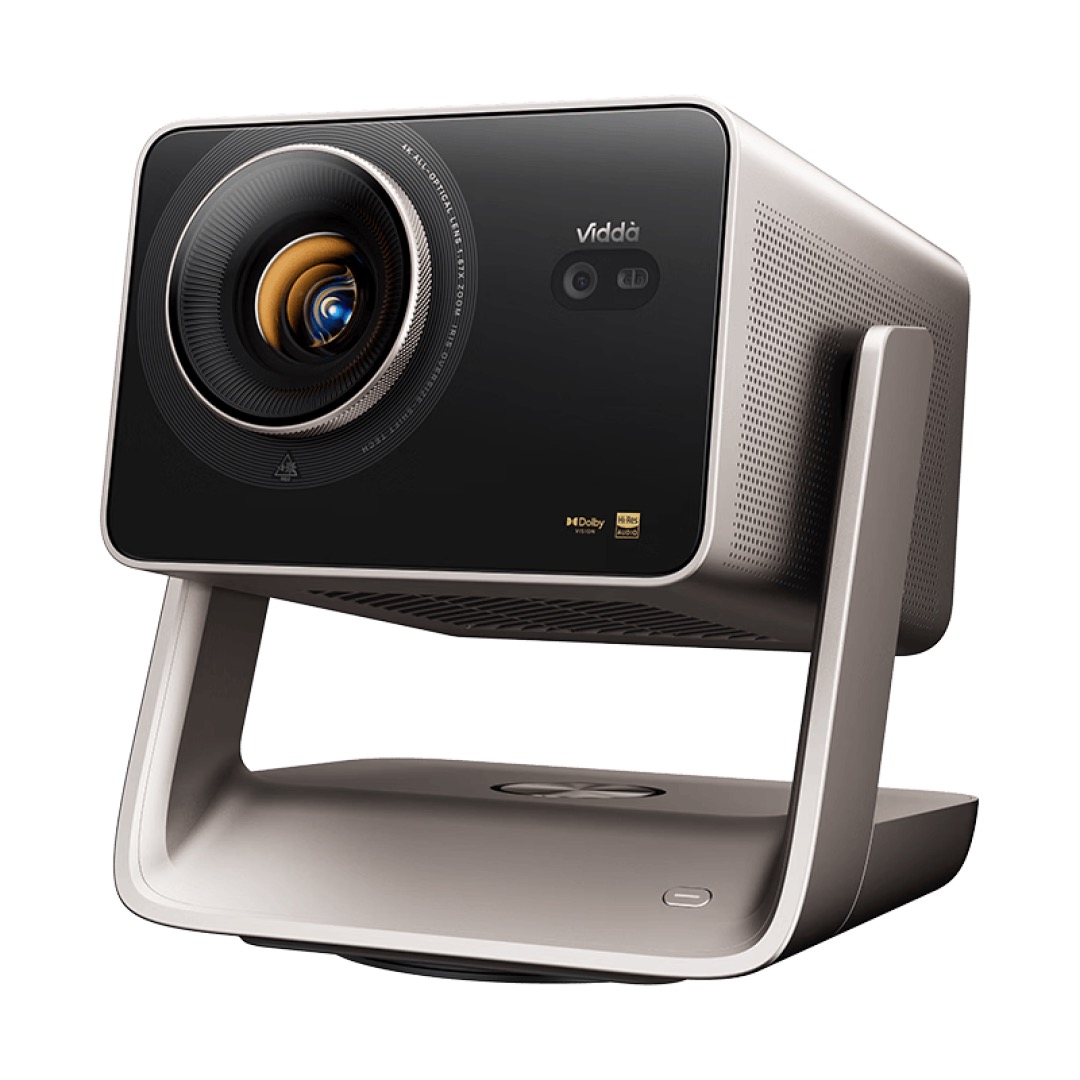
Vidda C5 ProMax Review 2026: 4K Triple-Laser Projector at ¥5,860
The Vidda C5 ProMax is the 2026 answer to a stubborn question: how much triple-laser 4K projector do you actually get for under ¥6,000? On JD’s self-operated store the C5 ProMax carries a 99% positive rate on its listing — updated September 10, 2026, and ranked Top 13 in the platform’s Office Instruments popularity board — and the September deal stacks down to ¥5,860.36 from a ¥7,998 regular price, undercutting even the 618 peak of ¥6,653.91. For that money Vidda (Hisense’s projector brand) fits a 4K UHD DLP engine, a triple-color laser light source built on 20 Qualas 42 laser modules, a rated 3,200 CVIA lumens, a 5,000:1 contrast ratio with a seven-step F2.0–6.0 variable aperture, and — the feature that matters most in a real living room — motorized optical lens shift (vertical ±100%, horizontal ±35%) with 1.67x optical zoom for genuinely lossless side projection. Conclusion: ✅ the best-value 4K triple-laser flagship in the ¥5,800–8,000 band while the September deal holds; ⚠️ skip it if you need 4,000-plus lumens for daytime viewing or want a zero-setup budget box — that is Ultra/Master territory.
— the flagship of Vidda’s four-model C5 line, aimed squarely at the ¥6,000 living-room upgrade.
Specifications
| Specification | Detail |
|---|---|
| Model | Vidda C5 ProMax (triple-color laser 4K projector) |
| Display engine | DLP with 0.47-inch DMD (2025-generation upgrade) |
| Resolution / refresh | 4K UHD at 60Hz; 1080p at 240Hz |
| Light source | Triple-color laser — 20 Qualas 42 laser modules |
| Brightness | 3,200 CVIA lumens |
| Contrast | 5,000:1, with F2.0–6.0 variable aperture (7 steps) |
| Optics | 1.67x optical zoom; throw ratio 0.9–1.5:1 |
| Lens shift | Vertical ±100%, horizontal ±35% — lossless side projection |
| Processor / memory | Flagship MediaTek MT9681, 3GB RAM + 64GB storage |
| Audio | Self-developed 2.1 system (Hi-Res), 20W gimbal subwoofer; industry-only HI-RES AUDIO certification |
| HDR / picture modes | Dolby Vision, HDR10+, IMAX Enhanced, Filmmaker Mode |
| System UI | 4K UI (industry-exclusive) |
| Connectivity | Optical audio out, USB 3.0, HDMI 2.1, gigabit Ethernet, Wi-Fi 6 |
| Eye care / tuning | TÜV Rheinland zero-harmful-blue-light certification; customizable color calibration |
| Platform | JD self-operated listing (99% positive rate) |
| Price (2026-09) | ¥5,860.36 deal vs ¥7,998 regular; launched 2026-05-08 at ¥7,999, Tier-1 energy efficiency |
The headline spec is not any single number but the combination: a true 4K laser engine plus the kind of installation flexibility — optical zoom, big vertical and horizontal lens shift — that usually lives two price tiers up. The 3,200 CVIA rating is honest mid-flagship territory for 2026, and the 4K UI is the detail that separates Vidda’s laser family from half-finished rivals.
What Verified JD Owners Say
The 99% positive rate on JD’s self-operated listing is the number this review starts from, and it needs one honest caveat: the C5 ProMax launched on May 8, 2026, so its JD review base is younger and thinner than a mature TV’s. What we can verify is precise — the listing carries a 99% positive rate updated September 10, 2026, and the model sits in the Top 13 of JD’s Office Instruments popularity board, which for a new laser projector is a strong early signal that buyers are not returning it in meaningful numbers.
The more interesting story in the platform data is the price itself, because the “¥5,860” headline is a stack, not a sticker. The ¥7,998 regular price falls to ¥5,860.36 only when several layers line up: a 15% national trade-in subsidy, a one-yuan coupon worth 9.7% off, a 100-yuan e-card for posting a photo review after delivery, a 200-yuan e-card for a seeding post, a 200-yuan limited-time purchase e-card, and a further 200-yuan e-card if you leave a note to customer service. Several of those are store credit rather than cash off the card, so the effective out-of-pocket discount is smaller than the number suggests — the tracked cash-equivalent low with the subsidy alone is closer to ¥5,861. That is still the cheapest the model has been — below the 618 peak of ¥6,653.91 and every tracked offer since.
The pattern is what SMZDM’s community calls the “three-stage price drop” — a launch at ¥7,999, a first cut into the ¥6,000 band, and a second cut into the ¥5,800 tier. Buyers who want the deal should do the arithmetic before joining a group buy: the base number, not the badge, is what you are actually paying.
The caveats the 99% aggregate cannot hide are equally concrete. At 3,200 CVIA the ProMax sits below the C5 Ultra (4,400 CVIA), Master (4,700 CVIA) and UltraMax (5,800 CVIA), so in a bright, unshaded room it is a dim-the-lights projector rather than a TV replacement, and the deal itself is subsidy-dependent and disappears when the national program stops. Both are reasons to buy the right model at the right moment — which the next sections cover.
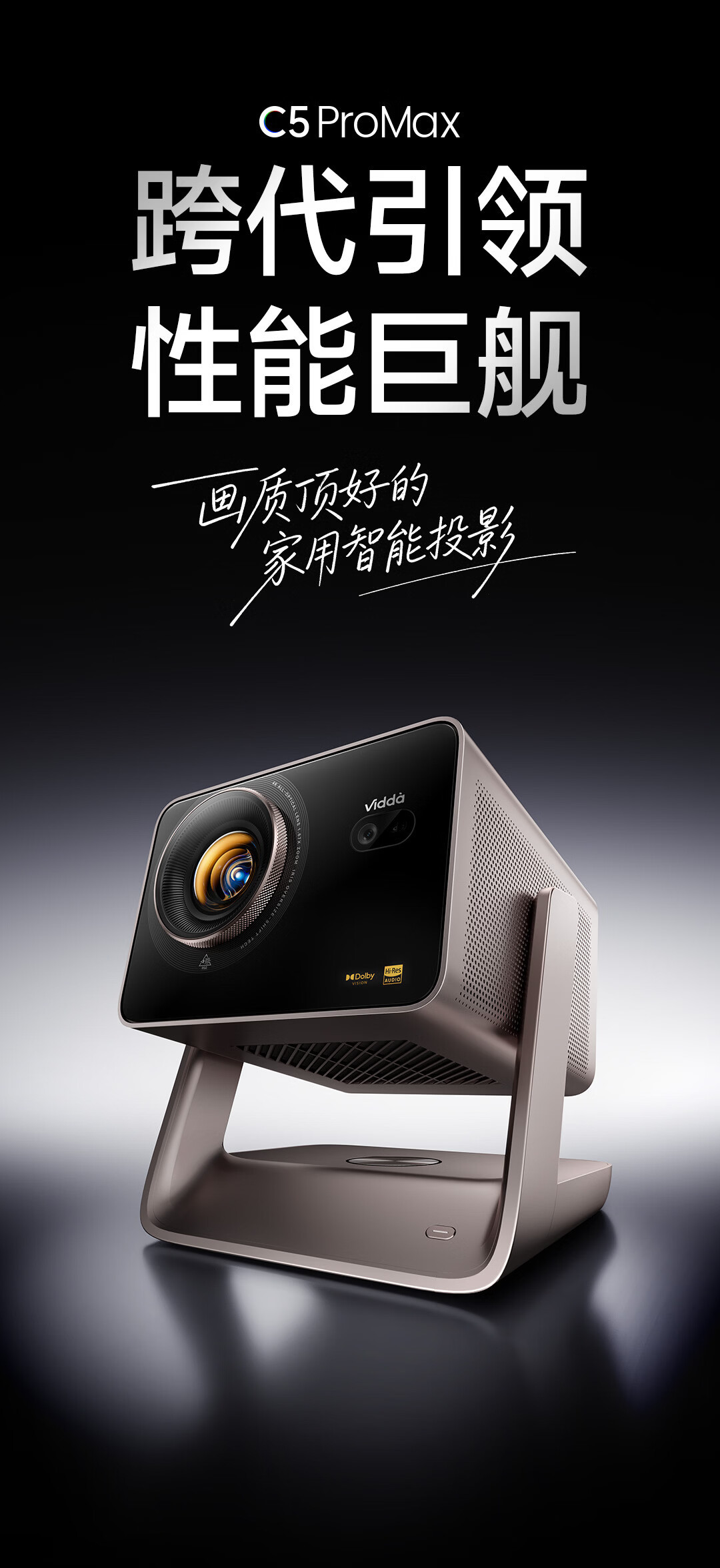 — optical zoom plus ±100% vertical and ±35% horizontal lens shift is the feature that lets the projector sit off-centre and still fill the screen.
What Xiaohongshu Users Say
Xiaohongshu’s C5 ProMax chatter is dominated by selection rather than complaint, which tells you where buyers’ anxiety actually sits: not “is it good?” but “which of the four C5 models do I need?” The single biggest note is a buyer’s guide — “From entry level to flagship: the Vidda C5 buying guide!” — Xiaohongshu user @MiDuoduo’s Home (1,701 likes) — and it is followed by a cluster of how-to-choose posts: “How to choose within the Vidda C5 series? A no-fuss guide to the four models” — @AnAn’s Cabin (815 likes) — and “Vidda C5: how to pick among the four projectors? One article explains it all” — @LaoLiuShops (269 likes). Read together, the guides frame the ProMax as the value pick of the family: the cheapest model that still delivers the full laser-plus-lens-shift experience, with the Ultra and UltraMax reserved for buyers who specifically need more brightness.
The purchase-and-ownership notes are quieter but reassuring. “Vidda projector: use it once and you won’t say a word” — @BirdOnTheRoof (125 likes) — captures the tone that recurs across the smaller threads: the picture quality is the kind owners stop commenting on because it simply looks right. A first-batch unboxing, “First-batch Vidda C5s ProMax unboxing” — @silence (54 likes) — plus “Bought a Vidda C5 ProMax projector” — @Shero (56 likes) — and “My Vidda C5 ProMax purchase experience” — @XiaoTingBao (25 likes) — form the early-owner record, alongside “Got the Vidda C5 ProMax” — @ZiyouZizai (2 likes). Notably, the one cross-model note in the whole tag, “Vidda C5 Ultra Max impressions” — @Pinocchio (11 likes) — is exactly the reality the guides warn about: buyers routinely weigh the ProMax against the Ultra, and most who compare within the family land on the ProMax because the brightness gap only matters in specific rooms.
The community presses one warning harder than the platform listing does: the group-buy flood. An SMZDM wiki note titled “15%-off group-buy and employee-purchase posts flood Xiaohongshu: the Vidda C5 Pro Max’s three-stage drop from 7,999 to the 5,800 tier — work out the base number before you join a group buy” is the clearest statement of the trap. When a new flagship drops fast, discount-hunting posts multiply, and not all of them are what they claim. The same community wiki rounds up the model-choice question in “2026 home projectors: XGIMI RS30, JMGO N5S and Vidda C5PM new models — how to choose?”, which frames the C5 ProMax as one of three serious 2026 entrants rather than a lone champion.
On the technical side, SMZDM’s dedicated explainer — “No more ‘discounted’ picture quality in side projection! A deep dive into the Vidda C5 series optical lens-shift tech” (SMZDM community post aww5q88g) — argues that the optical lens shift, not the brightness race, is the C5 line’s real differentiator for apartments where the projector cannot sit dead-centre. A separate community comparison, “4K laser projector: Vidda C3 Pro High-Brightness vs C5 ProMax — a non-review comparison” (SMZDM community post ad7wevgd), captures the other common dilemma: buyers weighing last year’s C3 Pro against the new C5 ProMax at a similar ¥6,000 budget. The broader selection guide “Must-read before buying: 26 home high-end projectors — the Vidda C5 ProMax/Ultra comparison explained in one go” (SMZDM community post az8n4ozn) supplies the full-family spec table most of these threads build on.
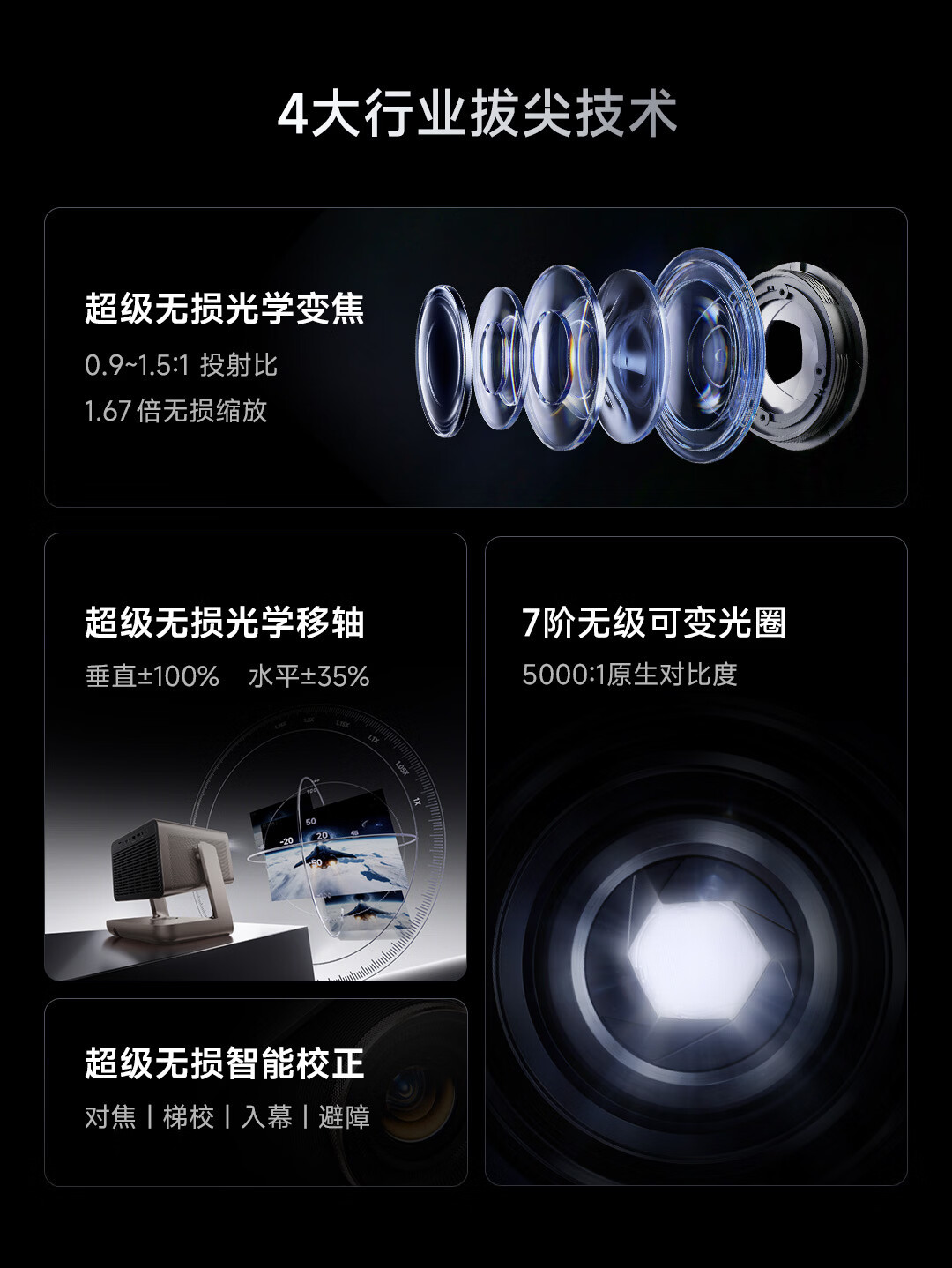 — owners on both JD and Xiaohongshu describe the picture quality as the feature they stop noticing, which is the highest praise a projector gets.
Vidda C5 ProMax vs Competitors (2026-09 Prices)
| Projector | Price (2026-09) | Brightness | Light source / note |
|---|---|---|---|
| Vidda C5 ProMax (this review) | ¥5,860–7,998 | 3,200 CVIA | 20 triple-color lasers; lossless lens shift; 99% JD positive |
| Vidda C5 Ultra | ¥9,999 | 4,400 CVIA | 32 MCL3A lasers; the first brightness step up |
| Vidda C5 Master | ¥11,999 | 4,700 CVIA | higher-tier flagship |
| Vidda C5 UltraMax | ¥14,999 | 5,800 CVIA | range-topping brightness |
| XGIMI RS30 | 2026 new model (JD self-operated class) | — | one of the three serious 2026 rivals |
| JMGO N5S | 2026 new model (JD self-operated class) | — | 2026 rival |
| Dangbei X7 Max | JD self-operated, 99% positive class | — | 2026 rival |
| DayanCheng C3 Max | ¥1,328 | budget class | the sub-¥1,500 casual alternative |
| XGIMI X50 Ultra Max | ¥18,249 | — | ten-thousand-yuan-plus reference tier |
The honest read: within Vidda’s own line, the ProMax’s 3,200 CVIA is the entry point, and choosing between it and the C5 Ultra (¥9,999, 4,400 CVIA) is a brightness-for-money trade that only matters if daytime viewing is your priority — everything the ProMax is praised for, from the triple-color laser to the lens-shift optics, is shared or superseded up the range, but at two to four times the price. Against the 2026 rivals — the XGIMI RS30, JMGO N5S and Dangbei X7 Max, all new models in the same JD self-operated, 99%-positive class — the ProMax’s edge is the combination of lossless lens shift, the industry-exclusive 4K UI and a deal price that undercuts the ten-thousand-yuan tier. At the very top, the XGIMI X50 Ultra Max at ¥18,249 shows what the luxury bracket buys; at the bottom, the DayanCheng C3 Max at ¥1,328 is the casual alternative if your expectations scale with its price.
 — the ProMax undercuts every other C5 model while keeping the full laser and lens-shift feature set.
Who Should Buy the Vidda C5 ProMax
✅ Buy if: you want true 4K triple-laser projection in a controlled-light room, and the ¥5,860.36 deal price makes it the most affordable full-feature 4K laser in the band. Buy it if you cannot mount the projector dead-centre — the ±100% vertical and ±35% horizontal lens shift with optical zoom solves side and shelf placement without a quality penalty. Buy it if you want one box that handles Dolby Vision film, IMAX Enhanced content and 4K/60 gaming through HDMI 2.1 without a separate soundbar, or if the brightness gap to the Ultra does not apply to your room.
💰 Cheaper alternative: if you just want a big picture for casual, lights-on viewing and do not need 4K laser or lens shift, the DayanCheng C3 Max at ¥1,328 is the entry route — accept the lower brightness, lower resolution class and no optical lens-shift flexibility. If you are already convinced by the C5 line but want to spend less, wait for the subsidy to reset and watch for the tracked cash-equivalent low around ¥5,861 rather than paying the ¥7,998 regular price.
⚠️ Skip if: you need 4,000-plus lumens for a bright, unshaded daytime living room — that is the C5 Ultra (4,400 CVIA), Master (4,700 CVIA) or UltraMax (5,800 CVIA), each at two to four times the price. Skip it if you want a zero-setup plug-and-play budget box, or if you cannot verify the deal stack — the headline ¥5,860 depends on a national subsidy and several e-card rewards, and it climbs toward ¥6,000–7,000 the moment the subsidy lapses. If a group-buy post promises a price far below the tracked range, treat it as noise until you confirm the base number.
FAQ
Q: Is the ¥5,860 price real, or is it e-card math? A: Both. The regular price is ¥7,998, and the ¥5,860.36 figure appears only when the 15% national subsidy, the one-yuan 9.7%-off coupon and up to four e-card rewards (100 + 200 + 200 + 200 yuan) stack. Part of that is store credit rather than cash off your card — the tracked cash-equivalent low with the subsidy alone is about ¥5,861. It is still the lowest price the model has seen, below the 618 peak of ¥6,653.91.
Q: Do I need the C5 Ultra instead? A: Only if brightness is your bottleneck. The ProMax’s 3,200 CVIA is plenty for a controlled-light living room, while the Ultra (¥9,999, 4,400 CVIA), Master (¥11,999, 4,700 CVIA) and UltraMax (¥14,999, 5,800 CVIA) each buy more brightness for two to four times the price. Xiaohongshu’s buying guides land on the same point: the ProMax is the family’s value pick, and the brightness upgrade only matters in specific bright rooms.
Q: What is optical lens shift, and why does it matter? A: It is motorized movement of the lens that repositions the image without digital keystone correction, so picture quality is not degraded. The C5 ProMax offers vertical ±100% and horizontal ±35% with 1.67x optical zoom — enough to place the projector off-centre or on a side table and still get a perfectly rectangular, full-quality picture. SMZDM’s technical explainer calls it the C5 line’s real differentiator for small apartments.
Q: Can it replace a TV? A: In a light-controlled room, yes — Dolby Vision, HDR10+, IMAX Enhanced and Filmmaker Mode plus the laser color coverage make it a credible main screen, and the self-developed 2.1 speakers with a 20W gimbal subwoofer mean no separate soundbar for casual viewing. In a bright daytime living room, no: at 3,200 CVIA you will be dimming lights or closing curtains, which is the honest limit of this price tier.
Q: Is it worth waiting for another price drop? A: The trajectory suggests the ¥5,800 tier is the current floor: the model launched at ¥7,999, peaked at ¥6,653.91 during 618, and has tracked between ¥5,860 and ¥6,061 through August and September. If the national subsidy ends, expect the price to return to the ¥6,000–7,000 band, so the deal window is tied to the subsidy rather than to Vidda’s pricing.
Q: Does it support 4K at high refresh rates? A: Yes — 4K UHD at 60Hz and 1080p at 240Hz, driven by a flagship MediaTek MT9681 with 3GB RAM and 64GB storage, making it suitable for both film (Dolby Vision, Filmmaker Mode) and high-frame-rate gaming through HDMI 2.1.
Rating
- Picture quality: 8.5/10 — triple-color laser with 5,000:1 contrast and a seven-step variable aperture; 3,200 CVIA is mid-flagship, not range-topping
- Installation flexibility: 9.0/10 — 1.67x optical zoom plus ±100% vertical and ±35% horizontal lens shift is class-leading at this price
- Features: 8.4/10 — 4K UI, MT9681, Wi-Fi 6, HDMI 2.1 and Hi-Res 2.1 audio; no obvious gaps
- Value: 8.0/10 — unbeatable when the subsidy-and-e-card stack lines up; noticeably weaker without the subsidy
- Overall: 8.3/10 — the value pick of Vidda’s C5 family: buy it at the ¥5,860 deal for lossless side projection and true 4K laser, skip it if you need Ultra-level brightness or a no-setup budget box.
Review based on SMZDM deal tracking (p/181934061, updated September 10, 2026), the SMZDM Vidda C5 ProMax specification comparison (community post az8n4ozn) and community explainers (posts aww5q88g and ad7wevgd), JD self-operated listing data (99% positive rate, Top 13 in Office Instruments), and Xiaohongshu search results for the Vidda C5 ProMax as of September 11, 2026. Prices are point-in-time and change with subsidies and coupons; e-card rewards are store credit, not cash.
Not sure which to choose?
Compare specs side-by-side with our Product Comparator Tool
Related Reviews

Anker MagGo 10K Slim Review 2026
Anker MagGo 10K Slim offers ultra-thin wireless power with MagSafe compatibility. We tested charge speed, heat managemen

Anker PowerHouse 535 Review: The 512Wh Multi-Day Power Solution
Anker PowerHouse 535 has 15,000+ reviews on JD.com with a 4.6/5 rating at ¥2,099 ($291). Users love the well-designed in

ARZOPA S1 Table Monitor Review: The Portable Screen That Doubles as a Desk Display
The ARZOPA S1 Table Monitor offers a 15.6-inch 1080p IPS display with dual USB-C connectivity and built-in kickstand. 4.

Baseus 600W Portable Power Station Review: Compact LFP Power for Outdoor Adventures
Baseus enters the portable power station market with a compact LFP (LiFePO4) unit. With 2,100+ reviews on JD.com and 94%

Baseus Portable Fan Review: The Clip-On Camping Breeze
Baseus portable clip-on fan has 80,000+ reviews on JD.com with a 4.5/5 rating at ¥49 ($7). Users love the powerful airfl