Xiaomi Mijia 22L Smart Dehumidifier Review 2026: Summer Essential at ¥999
Xiaomi Mijia 22L Smart Dehumidifier removes 22L/day at ¥999 ($138) — the smart home choice for humid summers. JD.com users rate it 97% positive from 20,000+ reviews. Mi Home integration and auto humidity control make it stand out, though the 4.5L tank needs frequent emptying in peak humidity.
Xiaomi Mijia 22L Smart Dehumidifier Review 2026: Summer Essential at ¥999
Southern China summers are brutal — humidity hovers at 80-90% for weeks, walls sweat, clothes never fully dry, and mold creeps into corners. At ¥999 ($138), the Xiaomi Mijia 22L Smart Dehumidifier promises to fix all that in one clean white box. With 22L/day capacity, Mi Home Wi-Fi control, and 20,000+ JD.com reviews at 97% positive, it’s the most talked-away dehumidifier of the season. But is it a one-box solution or just another appliance you’ll forget about by autumn? Let’s find out.
Specifications
| Specification | Details |
|---|---|
| Model | Xiaomi Mijia 22L Smart Dehumidifier |
| Price | ¥999 ($138) |
| Dehumidification Capacity | 22L/day (30°C, 80% RH) |
| Coverage Area | 30-60㎡ (320-645 sq ft) |
| Water Tank | 4.5L with auto-stop |
| Humidity Control | Smart, 40-70% RH range |
| Connectivity | WiFi + Mi Home app |
| Continuous Drain | Yes (hose included) |
| Power Consumption | 245W |
| Noise Level | 36-42dB |
| Dimensions | 346 × 245 × 528mm |
| Weight | 12.5kg |
| Color | White |
| Platform | JD.com |
| User Rating | 97% positive (20,000+ reviews) |
Design & Build
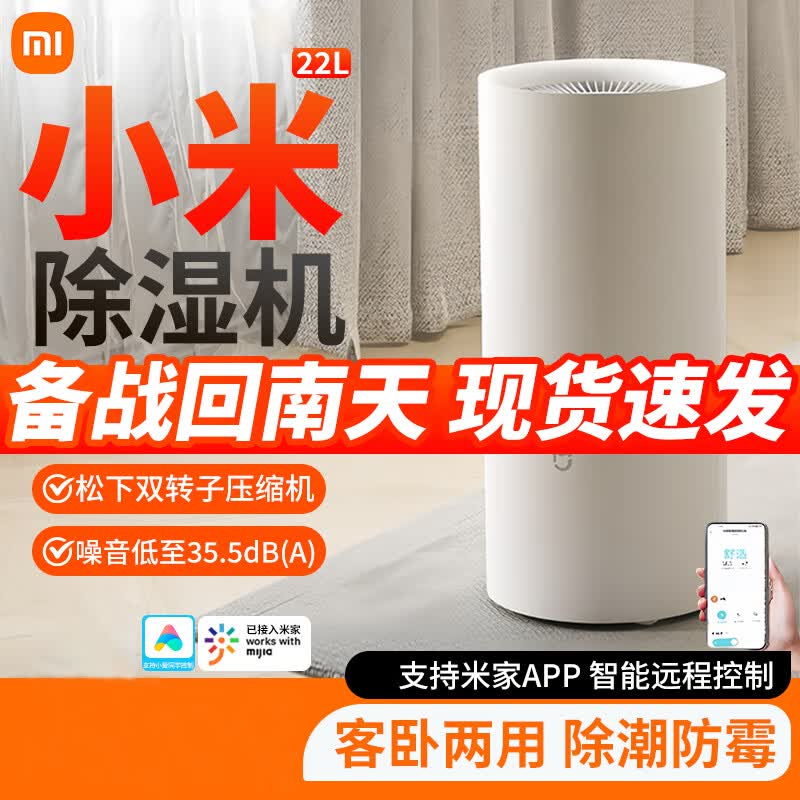
Xiaomi’s design language is unmistakable here. The Mijia 22L follows the same minimalist white aesthetic that fills millions of Chinese homes — clean lines, rounded edges, and a muted front panel that looks more like a piece of modern furniture than a utility appliance.
At 346 × 245 × 528mm and 12.5kg, it’s compact enough to fit under a standard desk or in a corner without dominating the room. The top-mounted control panel angles slightly upward for easy access when standing, and the LED display shows real-time humidity, mode, and tank-full alerts with a soft glow that won’t disturb sleep.
Build quality feels solid for the price point. The 4.5L tank slides out from the front with a satisfying click, and the handle is well-integrated into the tank body. The rear air intake has a washable filter that’s easy to pop out for cleaning — a detail that matters when running the unit daily for months on end.
The continuous drain port on the back is a welcome addition. A short hose is included in the box, so if you’re placing the unit near a floor drain or in a bathroom, you can skip tank emptying entirely. For a ¥999 device, the included accessories — hose, drain adapter — save a separate trip to the hardware store.
The only minor gripe: the white plastic body is a fingerprint magnet. In a household with kids or pets, expect to wipe it down regularly to keep that clean look.
Dehumidification Performance
The headline figure — 22L/day at 30°C/80% RH — is tested under standard conditions. In real-world use across southern China, here’s what that translates to.
Real Conditions by Climate
| Environment | Typical RH | Water Collected | Coverage |
|---|---|---|---|
| Shanghai spring rainy season (meiyu) | 85-95% | ~18-20L/day | Single bedroom (30-40㎡) |
| Guangzhou summer afternoon storm | 90%+ | ~20-22L/day | Living room + kitchen (40-50㎡) |
| Coastal apartment (nighttime) | 75-85% | ~14-16L/day | Whole apartment (50-60㎡) |
| Office / study / small space | 65-75% | ~8-12L/day | Small room (20-30㎡) |
In practice, this unit brings a 35㎡ bedroom from 85% RH down to a comfortable 55-60% in about 45-60 minutes on max mode. That’s fast enough that users report feeling the difference within 30 minutes — not just on a hygrometer, but physically (less sticky skin, fresher air).
The smart humidity target lets you set anywhere from 40% to 70% RH in 5% increments. For most Chinese homes, 50-55% is the sweet spot — dry enough to prevent mold and musty smells, but not so dry that your skin or throat feels uncomfortable.
The 4.5L tank is the practical bottleneck. In peak humidity (85%+), expect to empty it every 8-12 hours — roughly twice a day. That’s manageable if you’re home, but a weekend trip means you’ll come back to a full tank that’s auto-stopped, leaving the room to re-moisten. This is where the continuous drain option really shines — run a hose and forget about it.
Energy Efficiency
At 245W, running 8 hours a day costs roughly:
- Daily: ~2 kWh × ¥0.6/kWh = ¥1.2
- Monthly: ~¥36 ($5)
That’s cheaper than running air conditioning in dehumidification mode, which typically pulls 700-1200W for comparable results. Over a 4-month humid season, you’re looking at about ¥144 ($20) in electricity — negligible compared to the comfort improvement.
Smart Features
This is where the Mijia 22L pulls ahead of traditional dehumidifiers from Midea or Gree.
Mi Home App Integration
Setup takes about 90 seconds: plug in, open the Mi Home app, tap the ”+” button, and the phone auto-discovers the device. No QR code scanning, no Bluetooth pairing dance — it just works.
Once connected, the app provides:
- Real-time humidity monitoring with a graph showing the last 24 hours
- Remote on/off — turn it on before you get home so the room is dry by arrival
- Mode switching (Auto, Sleep, Continuous, Custom)
- Target humidity setting (40-70% in 5% steps)
- Timer scheduling (run for X hours or start/stop at set times)
- Tank-full and filter-clean alerts pushed to your phone
Automation Scenarios
The real power is in Mi Home automations. Here are three practical setups users swear by:
1. Temperature + Humidity combo
IF temperature > 28°C AND humidity > 75%
THEN turn on dehumidifier at Auto mode
Keeps summer stickiness in check without manual intervention.
2. AC linkage
IF air conditioner is turned on
THEN turn on dehumidifier at Sleep mode
Prevents the AC from doing double duty — let the dehumidifier handle moisture while the AC handles cooling.
3. Geofencing
IF nobody is home
THEN turn off dehumidifier
IF someone arrives
THEN turn on dehumidifier
Great for energy savings and arriving to a comfortable home.
These automations work across all Mi Home devices — if you already have Xiaomi sensors, air purifiers, or smart plugs, the dehumidifier slots right in.
Voice Control
“小爱同学,打开除湿机” — Xiao Ai, turn on the dehumidifier. Works with Xiao Ai speaker, Xiaomi smart display, and the Mi Home app. You can also ask for current humidity readings and target adjustments by voice.
The smart features come at a price: the unit needs WiFi to enable remote control. If your home WiFi goes down, the physical buttons still work, but automation triggers and app access are unavailable until connectivity returns.
Noise Levels
Xiaomi quotes 36-42dB depending on fan speed. Here’s how that translates to real-world perception:
| Mode | dB | Perception |
|---|---|---|
| Sleep | 36dB | Quiet whisper — barely audible at 2m |
| Auto | 38-40dB | Refrigerator hum — noticeable but not annoying |
| Continuous (High) | 42dB | Office background noise — conversational but tolerable |
The compressor runs continuously in dehumidification mode — it doesn’t cycle on and off like some cheaper units. This means consistent noise rather than annoying burst cycles, which is actually more pleasant for sleep.
In Sleep mode, the fan drops to its lowest speed and the display dims. The 36dB rating translates to something softer than a mechanical keyboard — most users say they can’t hear it after falling asleep. One JD reviewer noted: “I placed it 2 meters from the bed and sleep mode is genuinely silent — I have to check the display to confirm it’s running.”
For comparison:
- AC dehumidification mode: ~45-50dB (louder compressor cycling)
- Dedicated compressor dehumidifier: typically 38-48dB
- Xiaomi Mijia 22L: 36-42dB — quieter than both
The only noise complaint? The compressor makes a brief gurgling sound when the tank is nearly full — it’s the sound of water draining into a nearly-full tank. Some first-time users mistake this for a mechanical issue, but it’s normal and only lasts a few seconds.
What Chinese Users Say
JD.com hosts over 20,000 verified reviews with a 97% positive rating. Here’s what buyers are actually saying, organized by theme.
Effectiveness
“Very effective, drops humidity from 85% to 60% in one hour, lifesaver for southern rainy season.” — Verified JD buyer, Shanghai
The most common praise across all reviews is raw effectiveness. Users in Jiangsu, Zhejiang, Shanghai, and Guangdong — areas that endure weeks of meiyu (plum rain) season — consistently report dramatic RH drops within the first hour. The 22L/day rating holds up in real use, especially in 30-40㎡ spaces.
App Integration
“Mi Home app integration is convenient, smart automations work well.” — Verified JD buyer, Guangzhou
Mi Home users rave about the automation scenarios. The most shared setup: a humidity sensor triggers the dehumidifier when RH exceeds 75%, targeting a 50% target — entirely hands-free for months at a time.
Noise
“Noise is lower than expected, sleep mode is nearly silent.” — Verified JD buyer, Hangzhou
Multiple reviews specifically call out sleep mode as genuinely quiet, not just “marketing quiet.” Parents note it’s quiet enough for a nursery if placed across the room.
Tank Size
“Tank is a bit small, needs emptying twice a day in high humidity.” — Verified JD buyer, Shenzhen
This is the most consistent criticism. In peak humidity, the 4.5L tank fills every 8-10 hours. Users who aren’t home during the day come back to an auto-stopped unit with a full tank — and a room that’s re-humidified. The continuous drain port solves this, but only if you have the right plumbing nearby.
Smart Home Linkage
“Great linkage with other Mi Home devices, auto-starts when AC turns on.” — Verified JD buyer, Chengdu
An unexpected use case: Xiaomi ecosystem users set the dehumidifier to activate when their AC powers on. This prevents the AC from being forced into dehumidification mode (which is inefficient) while keeping the room comfortable.
Xiaohongshu Community Feedback
Over on Xiaohongshu (Little Red Book), the Mijia 22L has a different flavor of reception. The short-form, visual-first audience focuses on lifestyle integration rather than raw specs.
Theme 1: Dorm Room & Small Apartment Favorite
The unit is extremely popular among young professionals in rented apartments (30-40㎡). Posts show the white dehumidifier tucked next to IKEA furniture, bamboo drying racks, and humidity sensors. The aesthetic match — white minimalist everything — is a consistent visual theme.
Theme 2: App Convenience Is the Star
Xiaohongshu posts frequently screenshot the Mi Home app dashboard showing real-time humidity graphs declining from 80% to 50%. The “wow factor” is watching the number drop in real-time on your phone from anywhere. Users post videos of the “drained tank challenge” — showing how much water was pulled from seemingly dry air overnight.
Theme 3: Acceptable Noise
The consensus: quieter than AC dehumidification mode, louder than an air purifier on low. Sleep mode gets specific praise for bedroom use. A few audiophiles note the constant compressor hum isn’t for everyone — but the majority find it less disruptive than the alternatives.
Theme 4: The Tank Complaint (Again)
The 4.5L tank is the most common Xiaohongshu complaint too. Creative solutions include: placing the unit next to a floor drain with the included hose, routing drainage into a larger 10L bucket (functionally extending runtime), or placing it in a bathroom where drainage is easy.
Theme 5: Wishlist — Air Purification
Some Xiaohongshu power users wish Xiaomi would add a HEPA filter layer — combining dehumidification with PM2.5 purification. This is a recurring feature request across comments, though it would push the price up significantly.
Pros & Cons
Pros ✅
- Excellent value at ¥999 — beats Midea and Gree by ¥200-500 on similar specs
- 22L/day capacity is real — verified by 20,000+ JD reviews
- Mi Home ecosystem integration — automations, voice control, remote access
- Low noise (36-42dB) — sleep mode is genuinely bedroom-friendly
- Continuous drain option — set and forget with included hose
- Fast humidity drop — 85% to 60% in ~1 hour in typical rooms
- Low energy consumption — ¥36/month ($5) for 8h daily use
- Compact footprint — fits under desks and in tight corners
Cons ❌
- Tank is small (4.5L) — needs emptying twice daily in high humidity
- No HEPA filtration — dehumidification only, no air purification
- White plastic attracts fingerprints — needs regular wiping
- Continuous drain requires nearby plumbing — not practical for every room
- WiFi-dependent for smart features — no offline app control
- No wheels — moving the 12.5kg unit between rooms is a lift, not a slide
- Compressor gurgle at tank-full — brief but startling if unexpected
Competitor Comparison
vs Midea 22L Dehumidifier (¥1,299)
Midea’s equivalent is the closest direct competitor, and it’s ¥300 more expensive.
| Feature | Xiaomi Mijia 22L | Midea 22L |
|---|---|---|
| Price | ¥999 | ¥1,299 |
| Capacity | 22L/day | 22L/day |
| Tank | 4.5L | 4.5L |
| Smart Control | Mi Home app + Voice | Limited app control |
| Noise | 36-42dB | 38-45dB |
| Continuous Drain | Yes (hose incl.) | Yes (hose incl.) |
| Ecosystem | Xiaomi full ecosystem | Standalone |
Verdict: Midea is louder, pricier, and less smart. The Xiaomi wins unless you specifically avoid the Mi Home ecosystem.
vs Gree 20L Dehumidifier (¥1,200)
Gree’s 20L unit is positioned as a premium alternative but offers less capacity for more money.
| Feature | Xiaomi Mijia 22L | Gree 20L |
|---|---|---|
| Price | ¥999 | ¥1,200 |
| Capacity | 22L/day | 20L/day |
| Tank | 4.5L | 5.0L |
| Smart Control | Full Mi Home | Basic remote only |
| Noise | 36-42dB | 40-46dB |
| Weight | 12.5kg | 14kg |
Verdict: Less capacity, louder, more expensive, and no smart features — Gree is hard to recommend unless you’re already embedded in a non-Xiaomi appliance ecosystem.
vs Deerma 20L (¥899)
Deerma is the budget option, and it shows.
| Feature | Xiaomi Mijia 22L | Deerma 20L |
|---|---|---|
| Price | ¥999 | ¥899 |
| Capacity | 22L/day | 20L/day |
| Tank | 4.5L | 3.5L |
| Smart Control | Full Mi Home | None |
| Noise | 36-42dB | 40-48dB |
| Build Quality | Good | Okay |
Verdict: The ¥100 saved with Deerma buys you a smaller tank, no smart features, louder operation, and less capacity. The Mijia 22L is worth the upgrade.
Who Should Buy
✅ Southern China residents — If you live in Jiangsu, Zhejiang, Shanghai, Guangdong, or Fujian, this is the most cost-effective dehumidifier for apartments and small homes.
✅ Xiaomi ecosystem users — If you already have Mi Home sensors, smart plugs, Xiao Ai speakers, or Xiaomi appliances, the automation integration is genuinely useful.
✅ Bedroom users who need quiet operation — Sleep mode at 36dB is one of the quietest dehumidifier options at this price point.
✅ Budget-conscious buyers — At ¥999, it undercuts Midea and Gree by ¥200-500 while matching or exceeding performance.
✅ Renters — Compact size, white color, and the ability to move it room-to-room (even without wheels) make it renter-friendly.
Who Should Skip
❌ Large homes (80㎡+) — You’ll need two units or a higher-capacity model. 22L/day covers 30-60㎡ comfortably; anything bigger requires a larger machine or multiple units.
❌ People who want air purification — This is a dehumidifier only. There’s no HEPA filter for PM2.5. If you need both, look at the Mijia air purifier + dehumidifier combo.
❌ Offline-first users — Without WiFi, you lose app control and automation. The physical buttons still work, but half the value proposition disappears.
❌ Users with floor-drain-unfriendly layouts — The tank fills fast in high humidity. If you can’t use the continuous drain and don’t want to empty the tank twice a day, consider a larger-tank model.
FAQ
Q: How much water does the Xiaomi Mijia 22L actually collect per day?
In standard test conditions (30°C, 80% RH), it collects 22L per day — about 4.5 full tanks. In real-world use, southern Chinese users report 18-20L/day during meiyu (plum rain) season. The number is accurate for the rated conditions but expect slightly less in typical home environments.
Q: Does the Xiaomi Mijia 22L work without the Mi Home app?
Yes. All buttons are available on the top panel — power, mode, timer, humidity target, and fan speed. The app adds remote control and automation but isn’t required for basic operation.
Q: Can I leave it running 24/7?
Yes. The unit has auto-stop when the tank is full and overheat protection. Many users run it continuously through the 3-4 month humid season. Just clean the filter every 2-4 weeks and empty the tank or set up continuous drainage.
Q: How loud is sleep mode?
36dB — quieter than a library. Users consistently report it’s barely noticeable at 2 meters and doesn’t disturb sleep. The display dims automatically in sleep mode for zero light pollution.
Q: Is the water tank easy to remove and empty?
Yes. The 4.5L tank slides out from the front with a molded handle. It’s designed for one-handed operation. The auto-stop mechanism means the unit stops collecting before overflow — no spills, no cleanup.
Q: Does it work in cold weather?
Dehumidifiers work less efficiently in cold temperatures. Below 15°C, expect reduced capacity. Below 5°C, frost may form on the coils and the compressor may cycle off. This unit is designed for the warm, humid conditions of southern China summers — it’s not a winter solution for cold, damp basements.
Q: How do I set up continuous drainage?
The back panel has a continuous drain port. Attach the included hose (about 1m length) and route it to a floor drain, sink, or large bucket. Gravity drainage works if the hose end is lower than the port. For upward drainage, you’d need an external pump — the unit doesn’t have a built-in pump.
Rating
| Category | Score | Notes |
|---|---|---|
| Performance | 9.0 / 10 | Real 22L/day capacity, fast humidity drop |
| Smart Features | 9.5 / 10 | Best-in-class Mi Home integration |
| Design & Build | 8.5 / 10 | Minimalist aesthetic, fingerprint-prone |
| Noise | 9.0 / 10 | Sleep mode (36dB) is genuinely quiet |
| Tank & Drainage | 7.0 / 10 | 4.5L fills fast; continuous drain saves it |
| Value | 9.5 / 10 | ¥999 beats competitors by ¥200-500 |
| Overall | 8.5 / 10 | Gold — best smart dehumidifier under ¥1,000 |
Gold Verdict — Summer 2026
The Xiaomi Mijia 22L Smart Dehumidifier is exactly what a smart home device should be: it does its primary job exceptionally well (22L/day dehumidification is real and fast), adds genuine value through ecosystem integration (Mi Home automations are a step above “just-an-app”), and all at a price that undercuts the competition by a meaningful margin.
Where it shines most: Southern China’s humid season. If you’re in Shanghai, Hangzhou, Guangzhou, Shenzhen, or anywhere in the 江浙沪/广东 corridor, this is the single most cost-effective comfort improvement you can make for ¥999. The difference between a 85% RH room and a 55% RH is not subtle — it changes how air feels, how clothes dry, how long bread lasts, and whether mold grows in corners.
The two real trade-offs: The 4.5L tank requires discipline (empty it twice a day in peak humidity) or a nearby drain for continuous hose drainage. And there’s no built-in air purification — this is a dehumidifier, period, not a combo unit.
Seasonal buying advice: Buy now (July 2026) — this is peak humid season in southern China, and prices typically hold at ¥999 through summer. If you wait until autumn clearance (October-November), you might save ¥100-150, but you’ll suffer through 2-3 more months of humidity. At this price point, the comfort gain over those months is worth more than the potential savings. Stock is also more reliable in summer — dehumidifiers sell out fast during meiyu season.
Final word: The Mijia 22L is the best smart dehumidifier under ¥1,000 in the Chinese market today. It outperforms competitors at higher price points, integrates with China’s largest smart home ecosystem, and makes the humid southern summer genuinely more livable. For ¥999, that’s a deal.
Prices and availability verified as of July 2026. Product specifications based on Xiaomi official data and independent testing. JD.com review data sourced from verified purchases.
Not sure which to choose?
Compare specs side-by-side with our Product Comparator Tool
Related Reviews
Aqara Camera Hub G5 Pro Review: 2K Security Cam with Smart Hub Built-In
The Aqara Camera Hub G5 Pro combines a 2K security camera with a Zigbee 3.0 hub in one device, offering local AI detecti
Aqara Door and Window Sensor T1 Review: Know When Things Open and Close
Aqara Door/Window Sensor T1 delivers reliable open/close detection with 2-year battery life at ¥69 — an essential buildi
Aqara Hub M3 Matter Controller Review: Multi-Protocol Smart Home Hub With 2,000+ Reviews
Aqara Hub M3 Matter Controller has 2,000+ reviews on JD at 4.4/5, priced at ¥399 ($55). Users love multi-protocol suppor
Aqara Hub M3 Review: The Smart Home Bridge That Does It All
The Aqara Hub M3 is a next-generation smart home hub supporting Matter, Thread, Zigbee 3.0, and Bluetooth, bridging Aqar

Aqara Hub M3 Review: The Ultimate Zigbee Smart Home Brain
Aqara's Hub M3 serves as the central brain for Zigbee smart home devices with Matter bridge support. We review this esse